
TikTok Shop · Affiliate strategy
Creators are merchants now.
Most brands don't have a creator problem. They have a follow-up problem. The samples went out, the videos got made — and then everything stopped. That gap is the whole job.

The problem
Creators aren't ad placements. They're storefronts.
A creator with a shop tab isn't a media buy you run once and measure. They're a merchant — with their own audience, their own catalogue, and their own reasons to sell your product or quietly stop.
Treat them like a campaign and you get one video. Treat them like a merchant you're in business with, and you get a channel.
Misread 01
Recruitment isn't activation
Brands count signups and samples shipped. Neither is revenue. The only number that matters is how many are still posting in month three.
Misread 02
The sample isn't the finish line
For the owner, shipping is where the process ends. For the creator it's where their decision starts — and nothing is built to influence what happens next.
Misread 03
Nobody owns the middle
Ops ships. Marketing advertises. Between a creator's first video and their second there is no owner at all. That's where revenue leaks.
It looks the same in almost every account I open. A representative audit — call it Brand X.
Brand X didn't have a reach problem. Nearly two thousand merchants had already agreed to sell for them. Nobody was treating them like partners after the first sale.

Method
Three principles I run everything through.
01
Activation beats acquisition
A second video from a creator who already posted is far cheaper than recruiting a new one. Most programs ignore this and keep spending at the top.
02
Segment by proof, not warmth
A creator who converted once beats a friendly creator who never has. I start with the people who've shown they can sell your product.
03
Automate follow-up, personalise the relationship
Nudges, reminders and recovery should run themselves. Human time goes to the creators who actually drive revenue.

Practice
What I personally do.
Not a strategy deck handed over at the end. This is the work itself.
01
Lifecycle automation
Welcome, unfulfilled-sample, second-post and win-back sequences, switched on so the funnel runs without supervision.
02
Behavioural segmentation
Group creators by what they've actually done, then write the outreach that goes to each group.
03
Content briefs
Hooks, demo requirements, approved claims and a purchase CTA, so content ships against a standard instead of a guess.
04
Social intelligence
Trend and competitor passes every cycle to find what's converting now, fed straight back into the briefs.
05
Top-creator nurture
Spot converters early: early launch access, exclusive deals, retainer conversations before they drift.
06
Contest & incentive design
Challenges that reward revenue quality rather than raw video count, with payout gates tied to real outcomes.
07
Paid amplification
Proven organic videos turned into Spark Code campaigns with usage rights secured.
08
Reporting against benchmarks
Hit rate, retention, request rate and GMV measured against cohort norms, with a clear read on what changes next.

The engagement
The first thirty days.
You'll know by day 30 whether this is working. That's deliberate.
Week one · Audit
- Map every lifecycle moment
- Build the proven-converter segment
- Launch the first content briefs
- Baseline every metric
Week two · Switch on
- Re-engagement live on converters
- Recovery for overdue samples
- New outreach angles tested
- Reactivate the best proof asset
Week three · Push
- GMV-based contest launched
- Win-backs for creators gone quiet
- First trend pass
- Retainer talks with top performers
Week four · Measure
- Hook bank into the next briefs
- Faster sample approvals
- Results against targets
- Priorities set for month two

Evidence
Brand X — what changed.
A client affiliate program for 23 days before I took it on, then 27 days with affiliates actively managed. No increase in spend.
Source · TikTok Shop Product Analytics · hover to view unfiltered
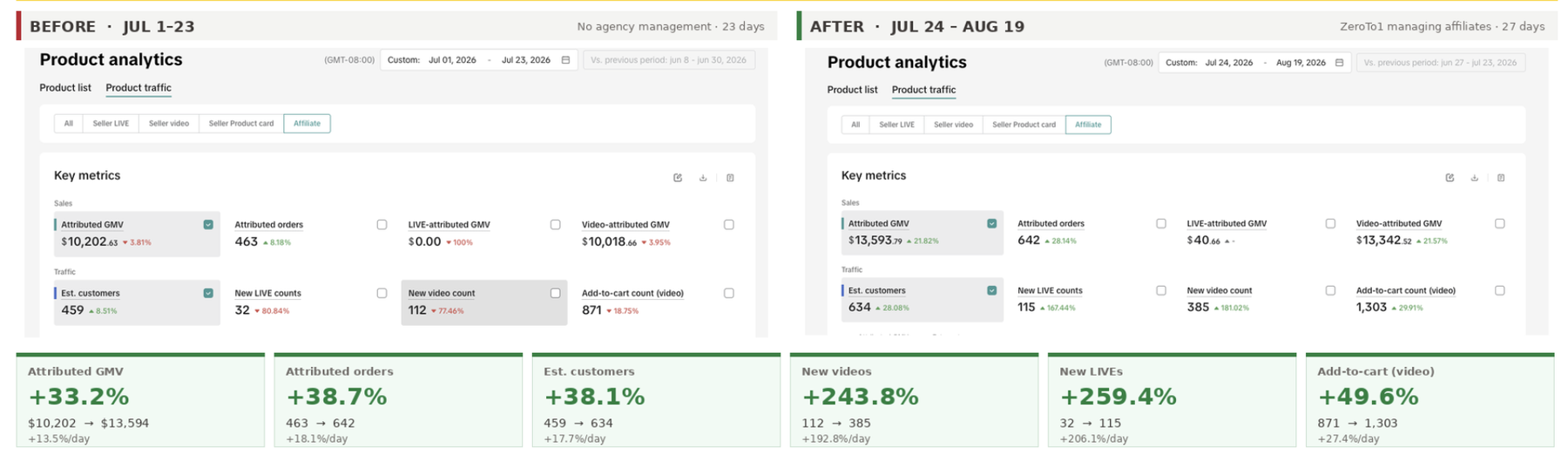
The interesting part isn't the revenue line. New videos and new LIVEs grew at roughly seven times the rate of GMV. Nobody spent more — far more creators simply started posting.
The two windows are different lengths, 23 days before and 27 after, so every figure is shown as a per-day rate alongside the total. These are one client account's results and are not a projection of what another account will do. Brand name withheld; full detail available on request.

Fit
Who this is for.
A good fit if
- You're a TikTok Shop brand or TSP with an existing creator base
- Hundreds of creators have posted once and gone quiet
- Samples are shipping but content isn't coming back
- Your automations are half-built or switched off
- You want someone in the account, not another deck
Not a fit if
- You're starting from zero creators — I'm not your first hire yet
- You want guaranteed numbers before any diagnosis
- You're looking for paid media as the primary channel
- You need a one-off audit with nobody executing after
Portfolio
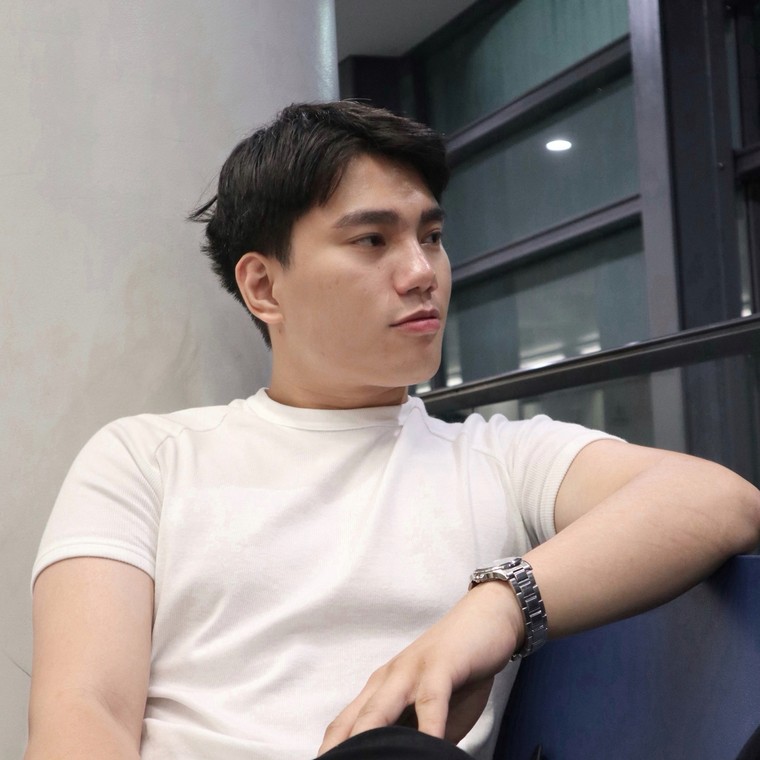
Hi, I'm Gabe.
I work where brand psychology meets automation. My job is finding the creators whose audience genuinely matches a brand — not just the ones with the biggest following — and then building the systems that keep those relationships running without anyone having to remember them.
Most affiliate programs fail on two things: fit and follow-up. The wrong creators get recruited, and the right ones get forgotten after their first video. I fix both — one with judgement, the other with automation.
gabrielmadlangbayan.business@gmail.com
Next step
I'll audit your funnel before you commit to anything.
Send me access or a screenshot of your affiliate dashboard. I'll come back with where the leak is, what I'd do first, and whether I think you actually need me.